
How's Digital Transformation reshaping Manufacturing's game
- Danip Social
- Dec 29, 2023
- 1 min read

Updated: Feb 13, 2024

In this fiercely competitive market, digital transformation is inevitable to stay afloat. It’s not only limited to the tech sectors, but the immensity of this revolution has entered into various other sections.
The world of the manufacturing sector is one of them. In the past few years, especially after the outburst of COVID-19, the evolving technology has completely changed the landscape of manufacturing. From production to inventory management, rising technology like artificial intelligence and the Internet of Things has revolutionized the manufacturing industry.
According to Statista, global spending on digital transformation is about to reach $2.51 trillion. It refers to the willingness of the companies to invest more in digitization, which will enhance the brand reputation.
Digital Transformation emerging as a supporting pillar in Manufacturing Industry
If you feel that your competitors are ahead and you still don’t know where to start, this blog is meant for you. We will discuss how digital transformation is impacting the manufacturing industry and what benefits you can reap for your business.
Let’s dive in.
What’s Digital Transformation in the Manufacturing Industry?
This refers to implementing digital tools and technologies with the existing traditional processes. From designing to manufacturing, supply chain management, and customer service- the role of the digital revolution is vital. The goal of this transformation is to reduce costs, improve efficacy, and enhance overall manufacturing competitiveness.
Cutting-edge technologies like big data analytics, the Internet of Things (IoT), and artificial intelligence enable manufacturers to gain valuable insights. These help to make informed decisions to improve the company's bottom line.
Benefits of Digital Transformation in Manufacturing
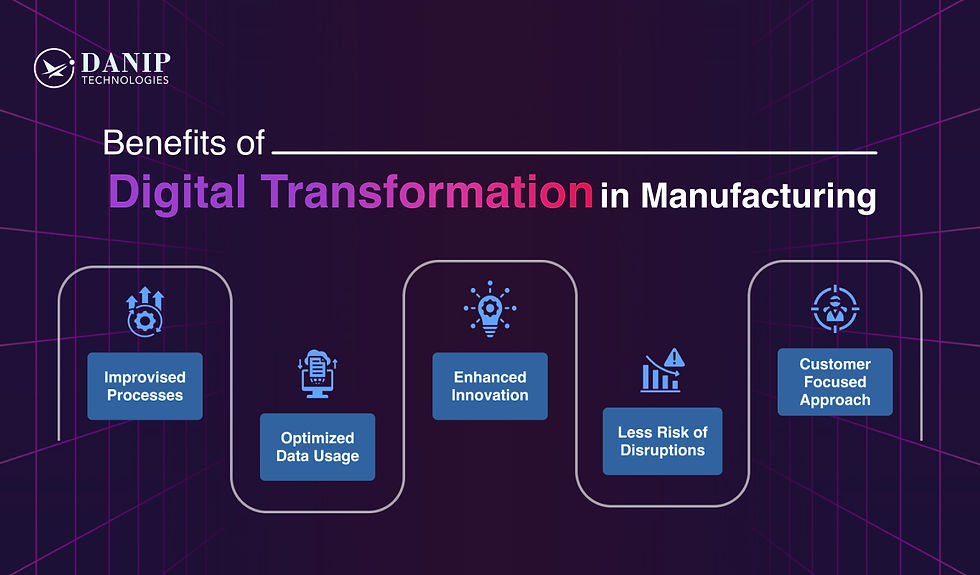
Digital technologies are emerging and are here to stay. Manufacturing companies are stepping up to complete their digitization efforts to generate more value in the long term by leveraging the benefits, including:
1. Improvised Processes
Digital transformation in the manufacturing industry is constantly upgrading operations. Real-time data analysis helps the company monitor, resolve, and predict the scenarios that lead to optimal machinery lifecycles. In turn, it enables the maintenance of error-free applications while avoiding costly reworks and disruptions.
2. Optimized Data Usage
With digitization, better data usage takes place within various operations. Manufacturers can incorporate the data effectively to enhance the efficacy of CRM, ERP, warehousing systems, and finance departments.
3. Enhanced Innovation
Strategized transformation creates the stage of holistic optimization. For instance, automated smart factory attributes in the ERP can improve the supply chain and overall business performance.
4. Less Risk of Disruptions
Troubleshooting, remote monitoring, and proactive maintenance in tandem with data are helping the manufacturers to prevent disruptions. Also, it can eliminate the necessity for a quick solution and its related risks.
5. Customer-Focused Approach
Manufacturers are now providing greater value to their customers through robust e-commerce platforms. Based on the customer demographics, separate portals for different regions are also helping the manufacturing companies to use sales data. This information helps predict customer demands while adjusting production accordingly.
Top 8 Trends of Digital Transformation in Manufacturing

A plethora of new technologies, including machine learning, big analytics, cloud computing, etc., is playing a key role in enhancing and improving the future of the manufacturing industry, like others. Here you go-
1. Internet of Things (IoT)
Digitization is all about playing with new technologies. One such key technology is the Internet of Things (IoT). It refers to the network of physical objects which communicate based on the accumulated data and the environment. Several manufacturing companies are embracing new functions and services provided by IoT, which enables them to excel efficiently.
From operations to asset management to personnel management, IoT is establishing preventative maintenance programs. It improves energy efficiency and presents work conditions with risk management, air management, worker productivity, etc.
2. Industry 4.0
This refers to the integration of industrial factories, traditional manufacturing, and smart technology across the supply chains. The goal of Industry 4.0 is to bring full-fledged automation processes where the existing processes are already automated.
For instance, industry 4.0 can be a machine that interacts with another one based on the information received through the sensors. This can be done without less human intervention.
3. Robotics
Automating repetitive tasks can help the manufacturing team perform efficiently, even when the workload is at its peak. On that note, robotic machines can perform complex tasks, including painting, assembling, and packaging. Additionally, they can cut the metal sheets into pieces, which is considered a difficult task. It provides safety to the workers and reduces the load of cumbersome tasks.
4. Machine Learning
AI and ML can mimic human intelligence by enabling real-time data analytics and autonomous systems. With machine learning, manufacturers are adapting to new data with less human intervention.
Some examples of machine learning are predicting waiting times, activity suggestions for employees, shipping times, and supply chain risk prevention behavior models. Another one is artificial intelligence in eCommerce. Here, the data generation by machines offers valuable insights into all aspects of production processes once integrated through the supply chain.
5. Additive Manufacturing
This is also known as 3D printing, which is a key technology for digital transformation in the manufacturing sector. It works by using digital 3D models. These models create the parts with the help of a 3D printer layer. This type of printing is cost-effective to create complex and intricate objects, including jewelry, medical, and aircraft parts.
New-age manufacturing companies include 3D printing in their strategy, which expedites manufacturing. In turn, it increases profitability and supports organizational improvements.
6. Augmented Reality
AR helps the manufacturing team to fuel the assembly process by using the AR glasses. It enables the workers to see information, including components' serial numbers, assembly guidelines, and real part projections. Thus, it facilitates easier and faster work procedures.
7. Digital Twins
This was coined by Michael Grieves in 2002 and implemented by NASA for the first time in one of their space exploration missions. The digital twin is a digital representation of a real-world thing. It can be a machine, a process, or a system, which enables the companies to assess better, evaluate, and optimize the manufacturing procedure through real-time simulation.
For example, a company can use this technology to understand why a particular part of a system is malfunctioning. Also, it can predict the product's lifetime. This real-time simulation helps the companies to improve product designs while ensuring the product's lifetime.
Examples of Big Brands Reaping the Benefits of Digital Transformation in the Manufacturing Industry
Siemens is one of the renowned companies that are leveraging digital transformation to foster the manufacturing process. They have incorporated cutting-edge technologies, including machine learning, artificial intelligence, and IoT, to enhance manufacturing procedures. Also, they’re following “Industry 4.0” to bring complete automation that will make manufacturing more efficient, easy, and reliable.
This brand has started a smart factory concept where they have interconnected all the plants through IoT. Additionally, they have installed cutting-edge sensors to accumulate data in real-time. This information is analyzed by the advanced tools to detect inefficiencies and the scope for improvement. Siemens is improving its product quality by monitoring its production processes with robust technology. This enhances the customer experience by catering to them with personalized services and products.
Ford is implementing big data analytics to enhance their supply chain management. With this technology, they can track their inventory in real-time while using predictive analytics to forecast demand. It has enabled them to reduce waste and improve the overall efficacy.
Also, Ford is using VR and AR to enhance the design procedure. These technologies enable this brand to create 3D car models while testing different designs without developing physical prototypes. It saves time and money in the long run to iterate design quickly.
How can Danip Technologies Help Improve the Manufacturing Processes?
With the help of skilled digital enthusiasts, Danip Technologies is one of the renowned digital transformation companies in India, catering to more than 50+ brands all over the globe. If you want to incorporate digital transformation for your manufacturing needs, we’re here to help take your brand to the next level. Reach out to know more.


Comments